Strength Training Equipment Explained: Racks, Benches and Functional Trainers
The core strength training equipment for most gyms comes down to three anchors and one essential partner. A power rack lets you lift free barbells safely, a Smith machine guides the bar on a fixed path, a functional trainer gives cable resistance from almost any angle, and an adjustable bench works with all three. The right choice depends on how you like to train, your experience and the space you have.
Reviewed by the Luxe Fitness equipment team, Bangalore · Updated 12 November 2026
Key takeaways
- A power rack suits barbell training and progressive heavy lifting, with safeties to catch a failed rep.
- A Smith machine guides the bar vertically, which many beginners and solo lifters find reassuring.
- A functional trainer offers the widest exercise variety and is joint-friendly through adjustable cable paths.
- An adjustable bench multiplies the value of any rack, Smith machine or cable station.
- Check floor space, ceiling height and loading clearance before choosing any weight training equipment.
What strength training equipment do you actually need?
Most people need one main station plus a bench and a modest set of free weights. Choose the station that matches your training style, rather than buying several machines that overlap.
A simple way to decide:
- You enjoy barbell squats, presses and pulls: start with a power rack.
- You train alone and want guided barbell movements: consider a Smith machine.
- You want variety, rehab-friendly movement or a family-friendly machine: choose a functional trainer.
- You want two of these in one footprint: look at combined Smith and functional trainer stations.
Health guidance supports making strength work a habit. The WHO physical activity guidelines recommend that adults do muscle-strengthening activities involving all major muscle groups on two or more days a week.
What does a power rack do, and who is it for?
A power rack is a steel cage with adjustable hooks and safety supports, letting you squat, press and pull with a free barbell while protected against a missed rep. It is the backbone of serious weight training equipment in both homes and gyms.
Why lifters choose a power rack
Free barbells move in a natural path and demand balance, so they train stabilising muscles along with the main movers. Safety posts or arms set just below the lowest point of the lift catch the bar if you cannot complete a rep.
A worked example
The Steelflex CLPR380 Power Rack 380 from the Club Line has weight-assist hooks, protective safety posts on each side and accepts the optional CLLA380S lat pulldown attachment. It measures 122 × 138 × 209 cm, and its product page advises about 1 m clear on each side for loading a 2.2 m Olympic bar and at least 2.4 m of ceiling height. The bar and plates are bought separately.
Planning points
- Anchor the rack to the floor for heavy use, as manufacturers often recommend.
- Use rubber flooring to protect the floor and the plates.
- Leave room to load plates on both sides of the bar.
What is the difference between a functional trainer vs Smith machine?
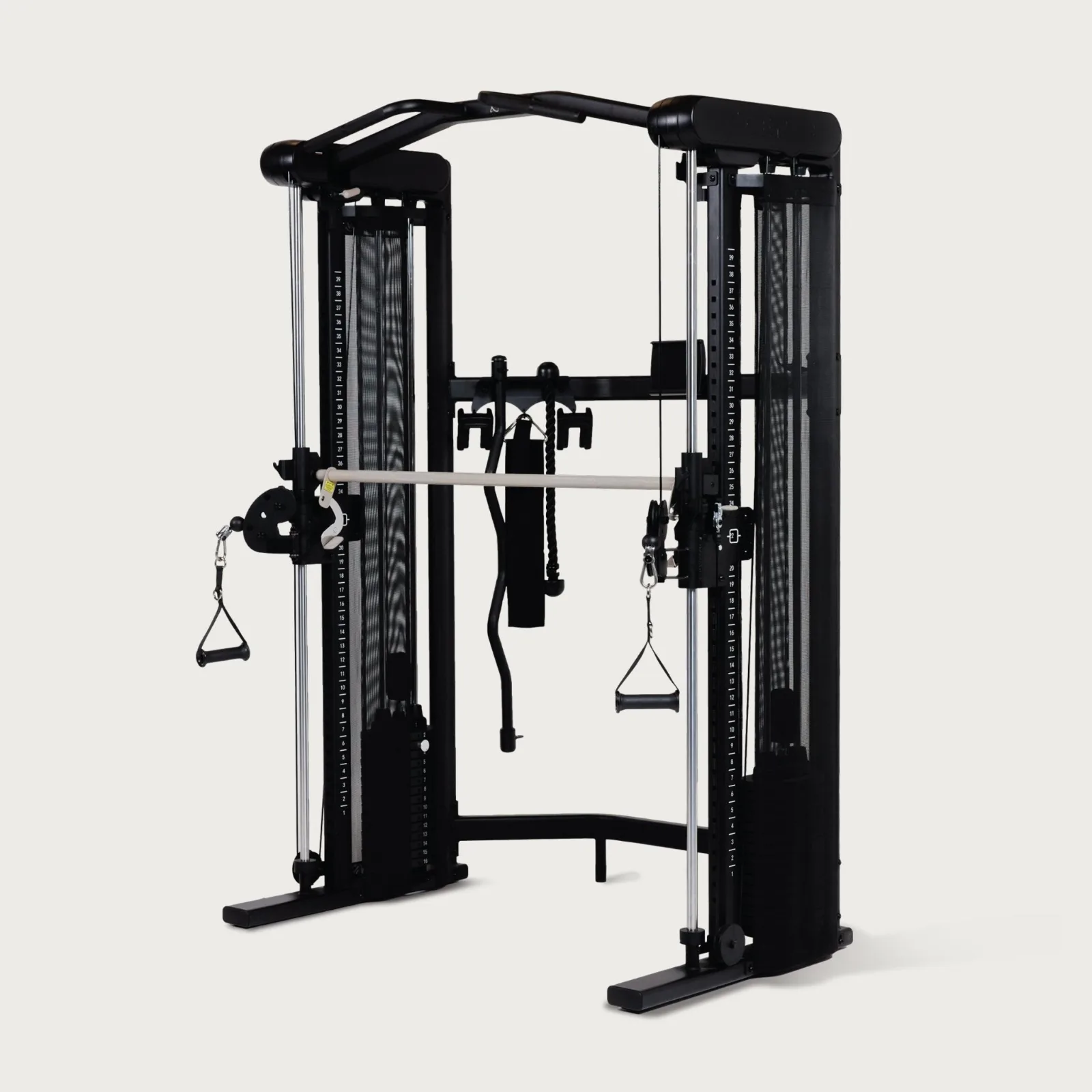
A Smith machine guides a barbell on fixed vertical rails, while a functional trainer uses adjustable cable pulleys that let you move freely in many directions. In short, the Smith machine adds stability; the functional trainer adds variety.
Smith machine strengths
The guided bar removes much of the balance demand, and bar catches allow you to stop at any point in the lift. This suits beginners, solo lifters without a spotter and anyone who wants to load the legs or chest with less concern about the bar drifting.
Functional trainer strengths
Cables let you press, row, pull, rotate and chop at almost any height and angle. Resistance stays smooth through the movement, and small weight increments make it useful for gradual progressions and rehabilitation under professional guidance.
Combined stations
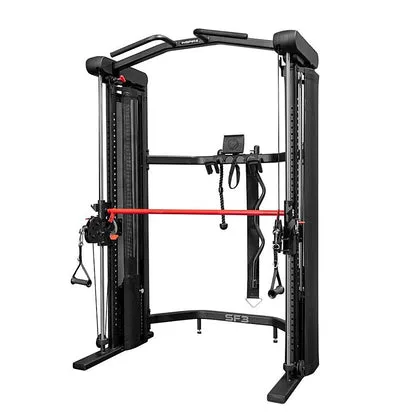
Some machines merge both ideas. The Inspire SF3 Smith Functional Trainer combines a stack-driven Smith bar with two pulleys driven by two 75 kg stacks, and a weight multiplier doubles the load on the Smith bar for heavier lifts. It occupies 150 × 117 cm, needs no plates and has a mount for a folding bench.
How do the main strength stations compare?
Each station solves a different problem. Use the table below to match one to your goals and room.
| Feature | Power rack | Smith machine | Functional trainer |
|---|---|---|---|
| Movement path | Free barbell | Fixed vertical rails | Free cable paths |
| Stability demand | High | Low | Moderate, varies by exercise |
| Exercise variety | Wide with a bench and attachments | Moderate | Very wide |
| Safety features | Hooks and safety posts or arms | Bar catches and safety stops | Selectorised stack, no free bar |
| Plates needed | Yes | Usually yes, unless stack-driven | No, uses weight stacks |
| Best for | Progressive barbell strength | Beginners and solo lifters | Variety, family use, rehab-friendly work |
Which bench should you pair with your equipment?
An adjustable flat, incline and decline bench is the most versatile choice for home and small facilities. Flat-only or specialist benches make more sense in larger commercial gyms with dedicated stations.
Look for these features:
- Several incline positions, plus decline if you want decline presses and core work.
- A load rating comfortably above your body weight plus the heaviest load you will lift.
- Stable feet, firm upholstery that wipes clean, and wheels for moving it.
- A footprint that fits inside or beside your rack or cable station.
If you are fitting strength equipment into a smaller room, our home gym equipment guide for Bangalore flats and villas shows how benches and stations fit typical spaces.
How much space does strength equipment need?
Allow for the machine's footprint plus working space in front and to the sides, and check the ceiling height for overhead movements and pull-ups. Racks also need room to load a full-length bar.
- Power rack: footprint plus side clearance for bar loading; generous ceiling height.
- Smith machine: similar footprint to a rack; space in front for stepping in and out.
- Functional trainer: open floor in front for lunges, presses and rotations.
- Bench: space to roll it in and out, and to lie down without hitting walls.
Browse the home strength range for household stations, or the commercial strength range for facility-grade racks, benches and machines.
Safety checks and when to get expert help
Strength equipment is safe when it is installed correctly and used with sensible loads. These checks matter most.
- Installation: racks and stations should be assembled, levelled and, where advised, anchored by trained technicians.
- Safeties set correctly: set rack safeties and Smith stops just below the lowest point of each lift.
- Load ratings: stay within the stated capacities of benches, racks and bars.
- Regular inspection: check cables for fraying, pulleys for free movement and bolts for tightness.
- Health first: if you have an injury, back or joint pain, a heart condition or are pregnant, take advice from a doctor or physiotherapist before starting or progressing a programme.
Luxe Fitness provides delivery, installation, after-sales service and spares, with warranty up to 5 years, model-specific.
About the author: The Luxe Fitness equipment team, Bangalore – backed by 28+ years of fitness-equipment experience through partner ACME Fitness.
Frequently asked questions
Is a power rack or Smith machine better for beginners?
Both can work. A Smith machine feels more stable at first, while a power rack with safeties properly set teaches free-bar control from the start.
Can a functional trainer replace a full gym?
For many home users, largely yes. It covers pushing, pulling, rotation and lower-body work, though heavy barbell lifting still needs a rack or Smith machine.
Do I need to bolt a power rack to the floor?
Bolting is often recommended for heavy use, and the Steelflex CLPR380 page advises it. Ask the installation team about your floor type.
What weights do I need with a power rack?
You need an Olympic bar, plates and usually a bench, as most racks are supplied without them.
Is strength training safe for older adults?
Strength training is generally recommended for adults of all ages, but older adults or anyone with health conditions should get medical advice and start with light loads.
See racks, benches and functional trainers at the Shanti Nagar showroom on KH Road, call +91 80 4112 5757, or book a strength equipment consultation.